Go Is the Right Default for Most Backend Teams - Here's the Evidence
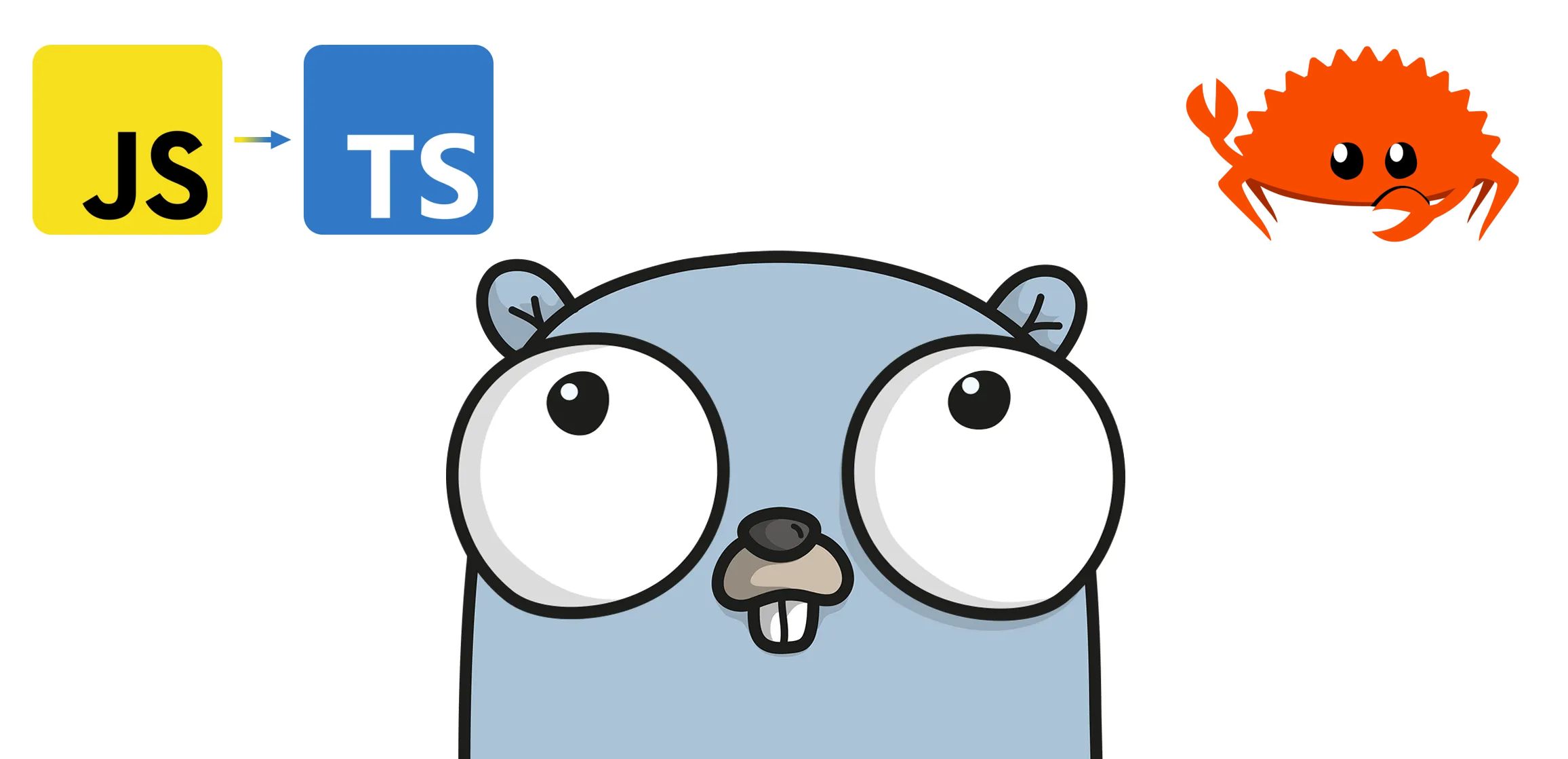
If you're a developer who's been writing TypeScript for a while and you've started wondering whether Go or Rust belong in your toolkit, this post is for you.
The short answer: Go should be your next language. Not because TypeScript is bad (it isn't), but because Go closes most of the gaps that TypeScript opens at scale, without the years of investment that Rust demands.
Let's work through why, with real benchmarks instead of toy examples.
What TypeScript Gets Right (and Where It Breaks Down)
TypeScript's dominance in backend development isn't accidental. If your team already knows JavaScript, your hiring pool is enormous, your ecosystem is unmatched, and you can move fast. For I/O-bound services like API gateways, CRUD apps, and anything spending most of its time waiting on a database, Node.js with TypeScript handles high concurrency well through its event loop.
The cracks appear at the extremes:
- CPU-bound work hits a wall. Node runs on a single thread. CPU-intensive tasks like heavy JSON processing, cryptographic operations, and data transformations block that thread and hurt everyone waiting in line.
- Memory consumption is high relative to Go and Rust under equivalent loads.
- Cold starts on AWS Lambda are painful. In controlled benchmarks, Node.js cold starts average around 130ms, over three times Go's ~40ms and more than six times Rust's ~21ms.
None of this is disqualifying for most teams. But it's worth knowing where the ceiling is.
The Benchmark That Actually Matters
Fibonacci(45), the example that appears in almost every language comparison, tells you almost nothing useful about backend performance. It's a single-threaded, garbage-collector-friendly micro-benchmark with no I/O, no concurrency, and no real-world analog.
Here's what does matter.
HTTP Throughput Under Concurrent Load
In a 2024 REST API benchmark run on AWS c6g.4xlarge instances (16 vCPUs, 32GB RAM) using wrk2 across 100, 1000, and 5000 concurrent connections:
- Rust (Actix Web) led at peak throughput across all concurrency levels
- Go (standard
net/http) performed strongly and consistently, with simpler code - Node.js (Express) lagged noticeably, especially at 5000 concurrent connections
The gap between Go and Node.js grows as concurrency increases. For services that need to stay responsive under load spikes, this is where the choice actually matters.
Cold Start Times on AWS Lambda
For serverless workloads, cold start time directly impacts user-facing latency and your bill, because provisioned concurrency isn't free.
| Runtime | Cold Start (avg) |
|---|---|
| Rust | ~21ms |
| Go | ~40ms |
| Node.js | ~133ms |
Source: nebjak.dev Lambda benchmark
Datadog's real-world migration, presented at AWS re:Invent 2025, tells a sharper story: their observability agent had Go cold starts of 700-800ms in production. Migrating to Rust brought that down to 80ms. That's not a benchmark. That's a customer experience problem getting solved.
The takeaway for serverless: Go is dramatically better than Node.js. Rust is better still, but the gap between Go and Rust is far smaller than the gap between Node.js and Go.
CPU-Intensive Workloads
In a throughput benchmark processing 1GB of JSON logs on Lambda:
- Rust and Go both completed the task in ~2 seconds at optimal settings
- Python took 8-12 seconds
- Library choice mattered significantly: Go's standard
encoding/jsonwas 10x slower thanvalyala/fastjsonfor this workload
That last point is worth sitting with. Language choice isn't the whole story. Ecosystem and library selection matter enormously within a language.
Developer Experience: The Real Tradeoff
Performance numbers don't exist in a vacuum. You have to hire for this language, onboard people to it, and maintain the code at 2am when something breaks.
TypeScript
Excellent developer experience for teams already in the JavaScript ecosystem. The toolchain is mature, the error messages are generally helpful, and your frontend developers can contribute. The tradeoff is that you're bringing JavaScript's runtime semantics along for the ride.
Go
Go's learning curve is genuinely gentle. Its standard library covers most of what you need for backend services without reaching for external packages. The concurrency model, goroutines and channels, is one of the cleanest abstractions for concurrent programming available in any language. Go's Stack Overflow 2025 survey results showed usage up two percentage points year-over-year. Kubernetes, Docker, Terraform, and Prometheus are all written in Go, and these aren't going anywhere.
A working HTTP service in Go is achievable in your first week. The ceiling on what you can do with it is very high.
Rust
Rust is in a different category. The borrow checker and ownership model require a genuine mindset shift. Expect 2-3 months before you're writing working programs comfortably, and 6-12 months before you feel truly productive. The payoff is real: memory safety without garbage collection, zero-cost abstractions, and performance that matches or exceeds C in most benchmarks.
In a high-concurrency JSON processing benchmark comparing Actix Web to Go's standard HTTP library, covering 1 million JSON documents, 100 fields each, and 1000 concurrent users, Rust achieved 1.5x the throughput of Go with 20% lower memory usage.
That's a meaningful gap. But it comes with a meaningful cost in developer time.
The Decision Framework
Here's the honest breakdown for a mid-level developer evaluating their options:
Choose TypeScript if: - Your team is already JavaScript-native and iteration speed is the priority - The workload is I/O-bound (database calls, external API calls, file reads) - You need the npm ecosystem - You're building a full-stack product and want shared types between frontend and backend
Choose Go if: - You're building a long-lived backend service and want predictable performance - You're deploying to AWS Lambda and cold starts matter - You're working on distributed systems, microservices, or anything with high concurrency - You want to learn a second backend language that pays dividends quickly - You care about binary size and memory footprint
Choose Rust if: - Raw performance is a hard requirement (high-frequency systems, game servers, latency-critical infrastructure) - Memory safety and correctness guarantees matter more than development speed - Your team has the runway to invest in the learning curve - You're building something like a database engine, compiler, or systems tool
The Bottom Line
For most backend teams, Go is the right next step. It's fast enough for the vast majority of production workloads, the developer experience is approachable, and the concurrency model is genuinely better suited to backend services than JavaScript's event loop.
TypeScript remains the right choice when ecosystem and team familiarity win. Rust remains the right choice when performance and memory safety are non-negotiable.
The question isn't which language wins. It's which language fits the workload, the team, and the timeline. Now you have the data to decide.
All benchmark sources are linked inline. Benchmarks vary by hardware, configuration, and workload. Treat them as directional signals, not absolute truths. When in doubt, benchmark your own workload.